UNSTUCK 044: Less Coffee, More What?
Prefer has nailed the procurement pitch, now it needs a reason for the rest of us to want it



In the last UNSTUCK we wrote about cultivated meat, an industry that spent six years collecting regulatory permission slips in Singapore only to find few people queuing at the counter. This time we’re looking at a startup with the opposite problem: buyers lined up at the door and not enough product to sell them.
Yes, that would be Prefer, the company that makes coffee without coffee by fermenting rice and chickpeas until they smell like a roasted bean, then roasting, grinding and spray-drying the result into something canned coffee and 3-in-1 sachet makers can blend into their products.
Their journey so far is well told by founder Jake Berber and boils down to every retailer rejecting them at first, then Prefer sticking their cans into vending machines to prove demand, and then getting into Shell and Sheng Siong stores across Singapore.
Finding a can was harder than the press releases suggested, but our expert panel agreed the taste beat Nescafé. What bothered the designers on the team was how low-end the packaging looked rather than how unusual the product was, which gives Prefer a rare problem in alt-food: a product good enough to beat its own branding. It’s a good one to have, up to a point.
Credit where credit is due: a smart strategy
It’s worth saying how much Prefer has got right, because most of it is exactly where alt-food has got it wrong in the past.
Start with who it’s for. Berber doesn’t hedge: “we’re a B2B company.” The cans, the vending machines and the forecourts aren’t the business, they’re the evidence. No consumer business with scale will put an unproven ingredient into its supply chain, so B2B players have to prove their worth first. Prefer’s playbook is to sell enough consumer product to show people will buy it, then sell the ingredient to the companies that make consumer products for a living.
The promise is refreshingly single-minded. It isn’t “the future of coffee” or “save the rainforest”. It’s “more stable, cost less, and taste the same”, aimed squarely at procurement teams who have spent two years watching arabica behave in ways nobody wants from a commodity. The ingredient name, PreferRoast, does selling of its own.
The target is just as disciplined: the mass market at around $10 a kilo, which covers 3-in-1 sachets, canned coffee, compound chocolate and baking, with savings of roughly 40%. Specialty coffee at $60–80 a kilo is, as Berber says, someone else’s problem.
Prefer also isn’t asking anyone to replace coffee, only to stretch it. Every product so far is a blend: 70/30 with Ajinomoto, 60/40 with Cerrad. Berber borrows the logic of blended meat, which lowers the bar from “convince me this is coffee” to “convince me nobody will notice”. That’s a much easier meeting to win. The partners signed so far suggest the traction is real, provided the first launches deliver.
And all of it has been done on $7M raised. Credit where it’s due.
The ticking time bomb
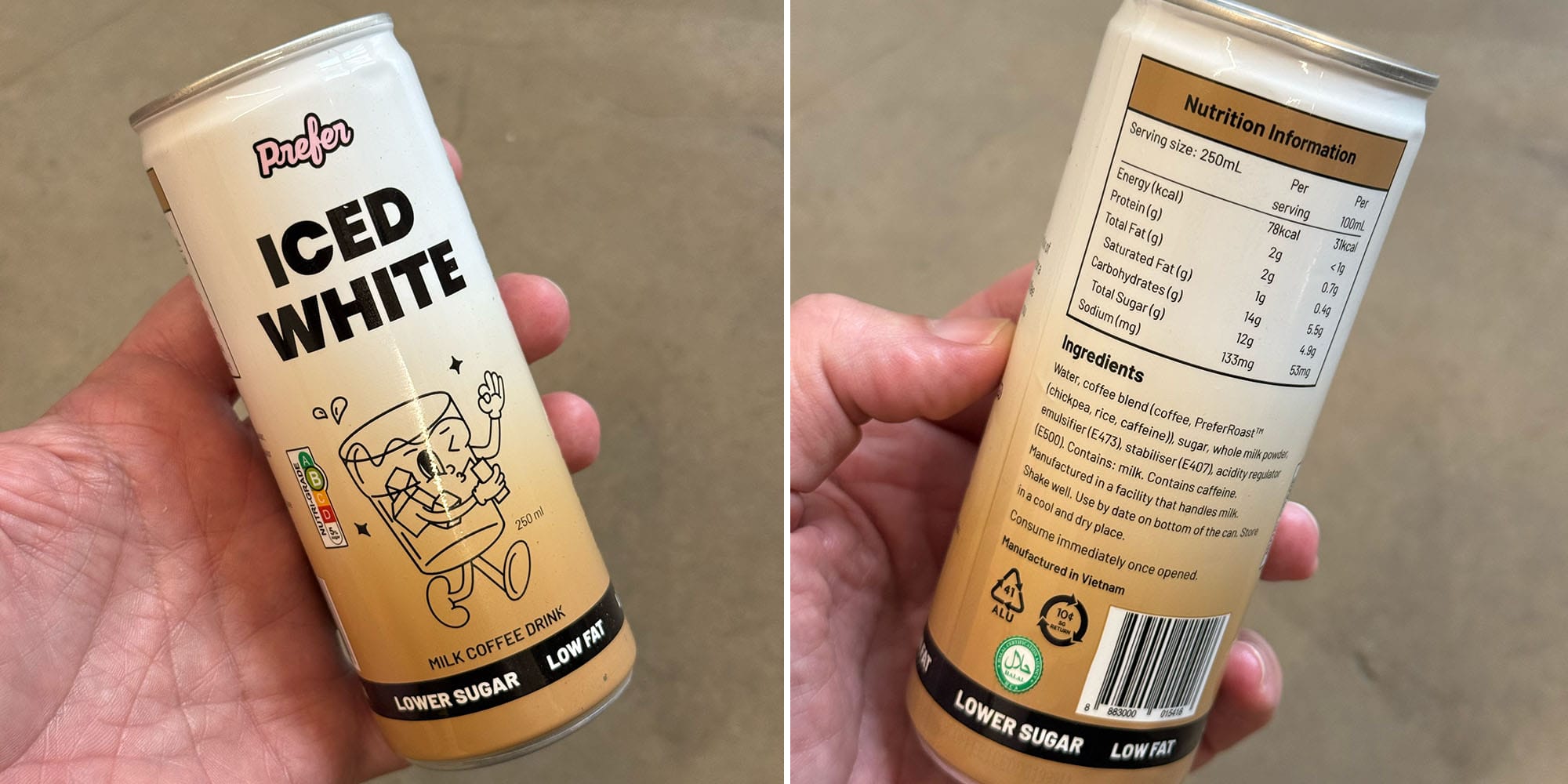
Look at the front of the can. You see Prefer, ICED WHITE, LOWER SUGAR and LOW FAT, and a cartoon glass of coffee that winks at you and makes the OK sign. Nothing says alternative or bean-free, and nothing would make a commuter think twice.
Now turn it around. Chickpea, rice, added caffeine, E473, E407, E500, made in Vietnam. Nothing is hidden, because it’s all disclosed where the law says it should be. But the front says nothing about why the back says so much, and that gap is a ticking time bomb. The timer is scale.
A vending machine only ever shows the front of the can, and Prefer’s consumer business has been built almost entirely in vending machines. So the sell-through numbers that impress procurement teams prove something narrower than they appear to: people will buy a coffee they can’t tell apart from the one next to it. Every step in the growth plan, starting with a factory that takes production from one tonne a month to 40 by early 2027, puts the back of the can in front of more people. Imagine Nestlé putting PreferRoast into a mass-market can and someone with a following reading the back out loud, the move that did so much damage to plant-based meat.
Actually, we don’t need to imagine it. In September Tesco banned or restricted 114 additives across its own-label products. Six weeks later the food-scanning app Yuka ran those 4,200 products through its database and found 30.6% still contained additives it rates as high-risk. Prefer isn’t on a Tesco shelf, but own label is exactly where an ingredient that “tastes the same and costs less” wants to end up, and that’s now where buyers ask why every additive is there and apps tell shoppers whatever the buyers missed.
The deeper problem is that the proposition is reductive (regular readers will know where we stand on that). Berber is admirably candid, describing the Ajinomoto pitch as a product that “tastes exactly the same and you could price 10 cents less”. And coffee, like cocoa and unlike palm oil, carries origin stories people care about, so substituting it reads as a loss.
The pitch has a second fuse, too: it assumes prices keep rising. That held when arabica hit a record $4.38 a pound in October 2025, but looks less true with arabica trading around $2.88 and the USDA forecasting a record 2026/27 crop. Cheaper coffee weakens a case built on price stability, just as the factory meant to deliver it comes online.
To be fair to Prefer, claimed concern about ingredients rarely shows up in the basket. The difference now is that shoppers don’t have to read labels, because Yuka reads them for them, and a strategy that relies on nobody looking tends to run out the moment a brand succeeds.
The bigger opportunity: from reductive to additive
Back to the front of the can. There’s room on it for a consumer benefit, and right now that room is filled with borrowed ones. “Lower sugar” and “low fat” could go on any milk coffee in the chiller. The ingredient that makes the whole thing possible has nothing to say for itself, which is why the back of the can reads like an accusation rather than an explanation.
That’s Prefer’s biggest opportunity, and its biggest risk. Like many in alt-food, it assumes that being B2B means skipping the hard consumer work. Prefer doesn’t need to stop being a cost story for buyers. It does need a second story for everyone else: one thing the ingredient does that coffee doesn’t, so the front of the can gives the back a reason to exist. That might be taste that beats parity rather than matching it, or a nutritional or functional benefit the fermentation and the chickpea can deliver. Sustainability, as always, belongs in the supporting cast. It’s a reason to feel good but rarely a reason to choose, and in coffee it collides with the fact that people care (not deeply, but enough) about supporting farmers, as decades of Fairtrade have taught us.
Today the cans test invisibility: can people tell the difference? (No.) Tomorrow they could test a benefit: do people choose this because of the difference? That’s evidence the commercial team signing off the decision can get excited about. A Nestlé CMO will champion an ingredient that sells more product, and resist one that only lengthens the ingredient list. And an ingredient that only saves money works until something cheaper turns up, or until coffee itself gets cheaper again.
Back to front
There is a bigger story here than just Prefer, it’s an important lesson for all alt-food innovators, and cocoa is showing us why. Milk chocolate is already a diluted product, with cocoa sharing the bar with sugar, milk and vegetable fats, so the question is the same with higher stakes. Cocoa carries even more origin and livelihood value than coffee. A purely reductive pitch will read as an even bigger loss, while an additive one could read as an upgrade.
Planet A Foods has just shown what that looks like. Its new Cocoa Booster replaces cocoa powder partly or entirely and, like PreferRoast, comes with a procurement story. Cocoa prices are up 70% since February, and Planet A says the ingredient can cut formulation costs by up to 50%. But it leads with two things Prefer’s can doesn’t have. First, a benefit: around 69g of fibre per 100g against cocoa’s 37g, about half the fat (a pitch they are aiming at GLP-1 users who eat less and choose more deliberately). Second, a back of pack with nothing to explain, because it’s one ingredient. The buyer gets the saving, and the shopper gets a reason to want it.
For now, all the front of Prefer’s can can do is wink. It’s a friendly wink, and it has sold coffee out of vending machines where nobody turns the can around. But Prefer is heading into other people’s coffee, where people will ask what all those ingredients are doing for them.
So here’s our question for Berber: when someone reads the back of the can out loud, what does the front say back?