UNSTUCK 037: How To Do Value Right
Brands are hollowing out and consumers are noticing


We’ve all noticed products around us getting smaller through shrinkflation. Some of us even noticed shrinkflation’s evil twin “maximiniflation” – when brands jack up prices while simultaneously degrading quality.
First comes optimizing ingredients to save cost. Then the portion size reduction. Then the price increases because input costs are up and shareholders expect growth. All while hoping consumers don’t notice.
They notice.
Products that cost more and deliver less, wrapped in the same packaging that once promised something better. This is the logical endpoint of the efficiency-obsessed mindset we wrote about in UNSTUCK 036.
Here’s the problem: this is a road to nowhere. A product can only be hollowed out so many times before consumers realize they’re paying more for less and they walk away or they start treating the brand like any other commodity and only buy when it’s the best price.
Prices are going up whether brands like it or not. Input costs, labor, logistics and regulatory requirements are not getting any cheaper. The question isn’t whether to raise prices. The question is whether brands will give consumers something worth paying for when they do.
A simple value equation: worth it or not worth it
The old playbook of raising prices, cutting costs, and hoping nobody notices is breaking down. And the data makes it painfully clear which bucket most mainstream brands are ending up in.
The clearest sign that mainstream brands are losing the worth-it test lies in private label. US store-brand sales hit a record $283bn last year, growing 30% since 2020 and outpacing branded goods for three consecutive years. In Europe private label commands nearly 40% of grocery by value. This isn’t just a price story either, with 71% of shoppers now rating retailer’s private label brands equal or better in quality than branded products. Consumers aren’t switching because they have to. They’re switching because the branded products that used to fill up most of their trolleys stopped being worth it, while private labels have improved their quality perception and kept costs low so they are increasingly seen as worth it. Walmart’s Bettergoods. Trader Joe’s. 365 by Whole Foods. These aren’t a small part of the basket any more.
The GLP-1 effect is the worth-it test on fast-forward. It’s projected that 35% of all food and beverages in five years will be bought by households using GLP-1. And recent Cornell research shows that grocery spending drops 5.3% within six months of starting the medication. When you’re eating less, every purchase has to justify itself. The fillers, like snacks and sweets, get cut first, and spending on nutrient dense food goes up dramatically. It’s a forced edit of the grocery cart, products that deliver something real stay in the basket, those that don’t disappear.
Pick a value lane and stick to it
Whether you’re an established player or a start-up, a consumer brand or a B2B ingredient supplier, the first strategic decision is where to play. Then you need to follow it through in everything you do. It sounds simple yet most businesses, big and small, struggle with both parts.
There are broadly three lanes. Value, mainstream, and premium. The 4Ps of marketing line up differently against each one, and the brands that thrive are the ones that own their lane completely rather than hedging across two.
Value: strip it back, own the efficiency. High volume, low margin, minimal brand investment. No bells and whistles. This is the world of private label and white-label manufacturing (often co-manufactured by larger-scale branded facilities). In the start-up world we’ve seen Tindle, a plant-based chicken company, recently announce it was divesting its US branded business to focus on B2B white-label in Europe. It’s a clear-eyed admission that without a differentiated product or the resources to build brand value, the only play is to try and be cheaper than the incumbent. Not glamorous, but commercially honest.
Premium: build desire, charge for it. Differentiated product, considered packaging, brand building at every touchpoint, and pricing that reflects the value delivered. Think Fever Tree, Poppi, Nespresso, Tony’s Chocolonely. In the world of cultivated meat, Forged by Vow is doing this with their Japanese quail grown from a single animal cell and served in high-end restaurants in Singapore and Australia. Not trying to imitate the mainstream. Building a category from the top down, exactly as food history tells us that categories should be built.
The middle: the hardest lane to hold. Years of efficiency optimization have eroded product quality here, often paired with brand investment being cut at the same time. As commodity prices in cocoa, coffee and meat hit record highs, mainstream brands are struggling to justify their price to consumers. This is also where the alt-protein graveyard resides. Companies like Beyond and Meatless Farms attempting branded plays without offering anything beyond parity products, now also tarnished by perceptions of being ultra-processed.
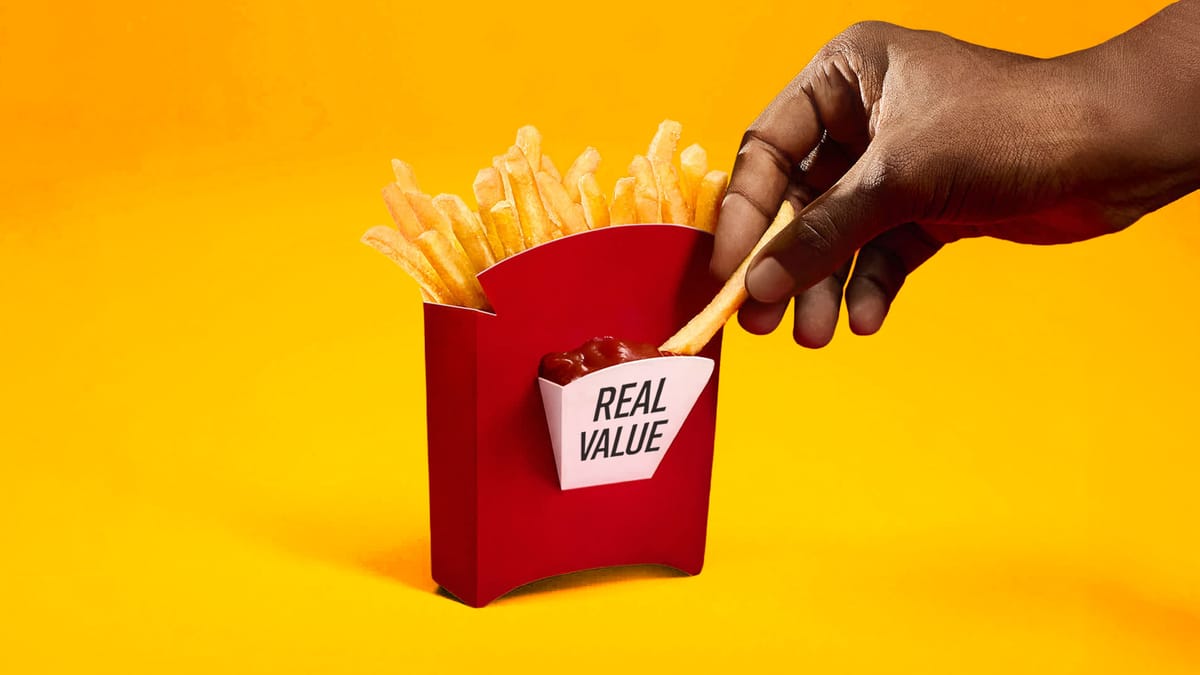
The middle isn’t dead, but it demands more than it used to. The Heinz Dipper, a french fries box with a pull-out compartment that can hold your favorite condiment, is a small example of how to do it. Genuine innovation that gives a fast-food outlet a real reason to stock Heinz over a cheaper white-label alternative and charge the consumer accordingly. Bravo Heinz. Someone pass the fries.
The only way out is to be clear on the value you are putting in
Pricing is largely being dictated by external forces: commodity costs, labor, logistics, and regulatory pressure. With all of them trending up, brands need to justify their value when the inevitable price rise comes.
Strip back to value and own the efficiency play with conviction. Build a premium and make every element of the proposition – product, packaging, distribution, brand – carry its weight. Or stay in the mainstream and innovate hard enough to make consumers feel the difference. What doesn't work is drifting. Charging premium prices while delivering commodity quality. Claiming to be a brand while competing on price. Promising innovation while delivering parity.
The brands that figure out their value value (whichever lane they choose) clearly, consistently, and credibly will be the ones commanding the greatest shelf presence when the dust settles.